Our proprietary platform
KITAI bodies

"From patient biopsies to
a first-in-class antibody."
- A first-in-class biological agent blocking HVEM
- Humanized single-domain (VHH) antibody
- Versatile and powerful building blocks
KITAI bodies are building blocks for next generation drug candidates, with the unique capacity to block two signaling pathways with one drug. KITAI bodies has demonstrated therapeutic effects in state of the art patient-derived glioma stem cells, where the tumor's ability to grow and spread was significantly decreased. KITAI bodies has the potential to slow down disease progression and increase the patient’s quality of life.

Glioblastoma
"Bridging the gap for
glioblastoma treatment."
Glioblastoma is the most aggressive primary brain tumor in adults and one of the most lethal human cancers. Except for age, no clear risk factors have been possible to identify, with late diagnosis as a result. Immediately after diagnosis, patients undergo an intensive treatment regime consisting of resection surgery, radiotherapy and Temozolomide (TMZ).
Due to tumor treatment resistance, relapsing after surgery is inevitable for the patient, the prognosis for the patient remains grim. Recent scientific breakthrough studies have identified that the cause of resistance is cancer stem cells. These stem cells are impossible to remove through surgery.
Increase in prevalence and with the currently inevitable relapse, an urgent need for efficient targeted therapy complementing surgery to prevent relapses and improve the prognosis for the patients.
Target biology
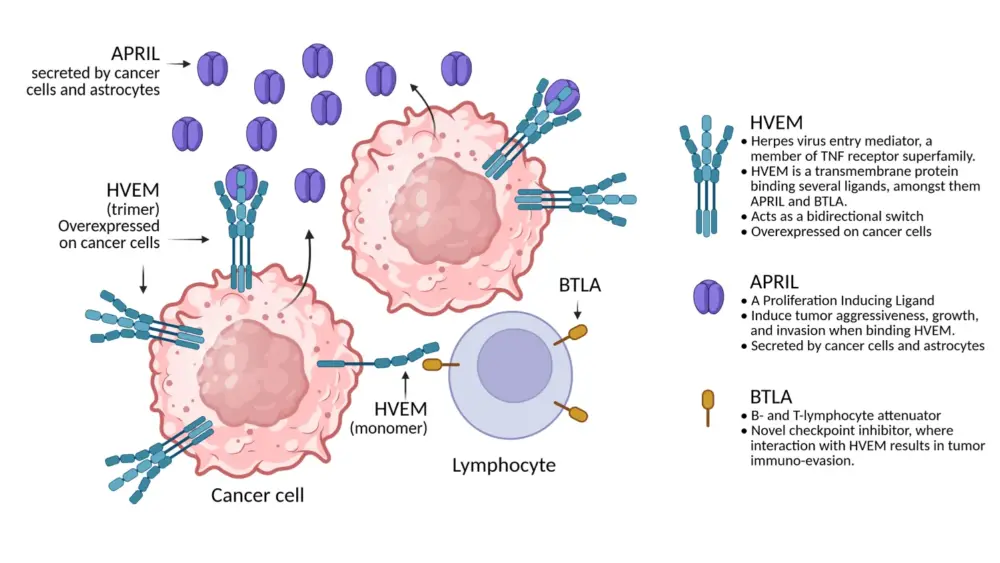
The HVEM receptor is overexpressed on the glioblastoma tumor cells, including the tumor stem cells. Via HVEM’s capacity to bind APRIL, the tumor cells receive signals, enabling growth and aggressive behavior. Via the HVEM-BTLA interaction, the tumor can also evade the immune cells, an important driver in tumor pathogenesis.
Image created in https://BioRender.com
Proposed mechanism of KITAI bodies
KITAI bodies has the capacity to act as an antagonist by simultaneously blocking APRIL and BTLA from binding to HVEM. By binding directly to HVEM overexpressed on the tumor cells, KITAI bodies has proven to hinder the tumor from proliferating and infiltrate into healthy brain tissue, thereby rendering the tumor less aggressive and unable to expand.
Image created in https://BioRender.com